California window tint laws are stricter than most drivers expect, and they apply differently to every window on your car. The front side windows must let at least 70% of visible light through. The rear side and back windows can be any darkness. And the windshield can only be tinted along the top four inches.
That’s the short version. Here’s what the rules actually mean in practice, what happens if your film is too dark, and how Sacramento drivers stay legal while still keeping the cabin bearable in July.
What Are the Legal Tint Limits in California?
The law is written around VLT — Visible Light Transmission — which is the percentage of light the film lets through. A higher number means a lighter film. 70% VLT is barely noticeable; 5% VLT is the near-black look people call limo tint.
| Window | California limit | What it means |
|---|---|---|
| Windshield | Top 4 inches only | A visor strip above the AS-1 line |
| Front side windows | 70% VLT minimum | Must be very light |
| Rear side windows | Any darkness | No limit |
| Rear windshield | Any darkness | No limit, but dual side mirrors required |
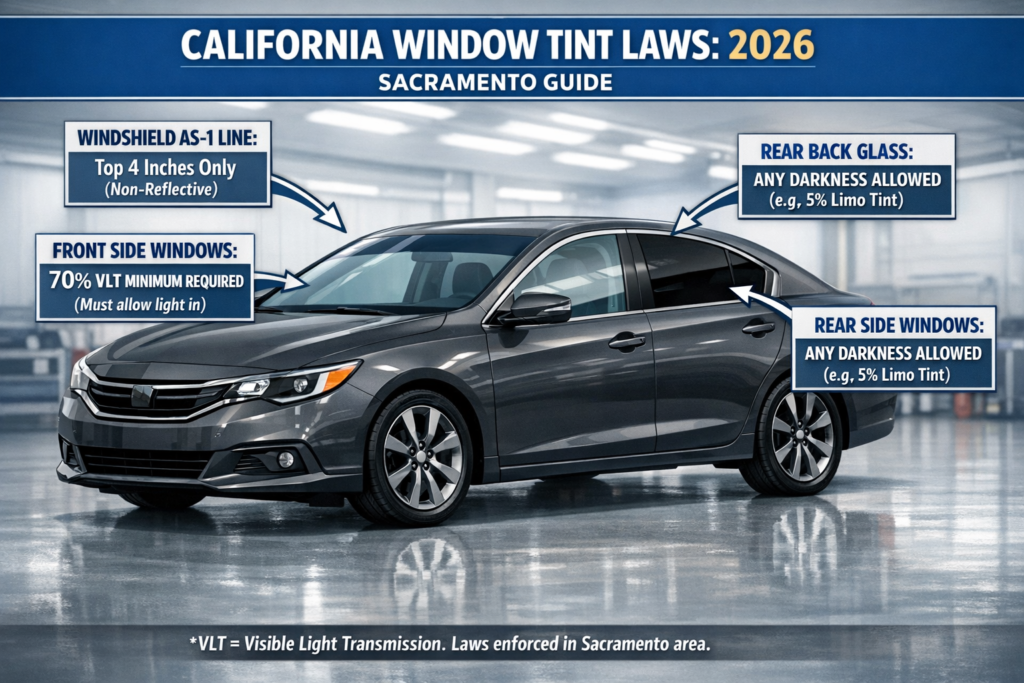
The rules come from California Vehicle Code section 26708, and the front-window limit is the one that catches people out. Most drivers assume they can go moderately dark up front. They can’t.
Is 35% or 20% Tint Legal on Front Windows in California?
No. Neither is legal on the front side windows. California requires a minimum of 70% VLT there, so 35% and 20% film are both well below the limit — as is 50%, which many drivers assume is a safe middle ground. On the rear side and back windows, however, 35%, 20% and even 5% are all permitted.
This is why so many Sacramento cars end up with a legal-but-light front and a much darker rear. It isn’t a styling choice — it’s the law drawing a line at the driver’s seat.
What Is the AS-1 Line on a Windshield?
It’s a small marking etched into the glass near the top of most windshields, usually on both sides. It marks how far down tint may legally extend. In California, film on the windshield is limited to the top four inches — roughly where that line sits.
Look closely at the upper corner of your windshield and you’ll usually find it. Anything applied below it is outside what the law allows.
Not sure whether your current film is legal? Request a free check and we’ll measure your VLT and tell you honestly where you stand.
What Happens If Your Tint Is Too Dark?
Illegal tint is typically handled as a correctable violation — often called a fix-it ticket. You’re required to remove the offending film and have the correction signed off, then pay an administrative fee. Repeat violations can be treated more seriously.
The practical cost is rarely the fine itself. It’s paying to remove film you just paid to install, then paying again for compliant film. That sequence is the single most expensive way to get your windows tinted.
If you’re in that position now, our guide to window tint removal in Sacramento covers what removal involves and why doing it properly matters before new film goes on.
Can You Get a Medical Exemption in California?
Yes. California allows an exemption for drivers with certain medical conditions that require additional protection from sunlight — conditions like lupus or photosensitivity. It requires signed documentation from a licensed physician or optometrist, kept in the vehicle.
The exemption isn’t automatic and it doesn’t remove every restriction, so it’s worth confirming the current requirements with your physician and the California DMV before assuming darker film is permitted.
How Do You Stay Legal and Still Beat Sacramento Heat?
This is the real question, because 70% VLT on the front windows sounds like it can’t do much. It can — if the film is the right type. Heat rejection and darkness are not the same thing, and modern ceramic film separates them.
A ceramic film at a legal 70% VLT rejects far more infrared heat than a cheap dyed film at an illegal 20%. You get the cooling without the ticket, because the technology is doing the work rather than the shade.
- Front windows: a high-VLT ceramic film keeps you legal and still cuts cabin heat.
- Rear windows: no legal limit, so choose based on privacy and night visibility.
- Windshield strip: the top four inches make a real difference to low afternoon sun.
For how the film types actually differ in heat performance, see our comparison of ceramic vs carbon tint.
Does Factory Privacy Glass Count Toward the Limit?
Factory privacy glass is tinted into the glass itself rather than applied as film, and it’s usually only fitted to rear windows — where California sets no darkness limit anyway. It’s worth knowing the difference: privacy glass can’t be removed, and adding film on top of it makes the glass darker still.
Does Factory Glass Affect Your VLT Reading?
Yes, and this is where drivers get caught out. Most factory glass already blocks some light before any film goes on. Apply a film rated at 70% VLT on top of glass that already reads 80%, and the combined result measures lower than 70% — putting an otherwise legal-looking install outside the limit.
It’s why the film’s rating on the box isn’t the number that matters. The measured result on your finished window is.
How Is Tint Actually Measured?
With a VLT meter — a small device clipped over the glass that reads how much light passes through. Law enforcement uses them roadside, and a reputable shop will use one before and after installation so there’s no guesswork about where your car sits.
One thing worth knowing: the reading includes your glass, not just the film. Factory glass already blocks some light, so a film rated at 70% won’t measure exactly 70% once installed. A shop that measures the finished result is the one giving you an honest answer.
How We Keep Sacramento Drivers Legal
We measure VLT on the finished install rather than relying on the film’s rating alone, and we’ll tell you before we start if what you’re asking for would put you outside the limits.
- 900+ five-star Google reviews from Sacramento drivers.
- Authorized 3M dealer with factory-trained, certified installers.
- Lifetime warranty on window tint installs.
- 10+ years on Arden Way, serving Sacramento.
See our full window tinting service for film options, or read the official rules at the California Highway Patrol.
Get a Legal Tint That Still Works
Tell us what you drive and how much heat you want gone, and we’ll recommend film that keeps you within California limits — measured, not guessed.