Walk into most Sacramento offices on a July afternoon and you can find the west-facing side of the building without looking at a compass. The desks nearest the glass are empty. Someone’s propped a monitor at an angle to kill the glare. The thermostat is set to 68°F and the room still feels like 78°F. For most Sacramento businesses, commercial window film energy savings start right here, at the glass.
That’s not an HVAC problem. It’s a glass problem — and commercial window film is the fix that doesn’t require touching your HVAC system, replacing a single pane, or shutting down for a week.
This guide covers where commercial window film energy savings actually come from for a Sacramento building, what else the film does, the one technical risk most vendors won’t mention, and how to decide if it’s right for your glass.
Why Sacramento Buildings Lose the Battle at the Glass
Sacramento averages a stretch of 100°F+ days every summer, and the sun sits low and west in the late afternoon — exactly when most businesses are still open and fully staffed.
Untreated commercial glass does almost nothing to stop that. Standard architectural glazing lets a large share of solar energy straight through. Once that heat is inside, your HVAC has to remove it, which means the system runs longer, works harder, and still loses the fight in the rooms closest to the windows.
Three things happen at once:
Uneven cooling. The rooms near glass run hot while interior rooms run cold, because the thermostat is averaging a building that isn’t behaving like one building.
Glare on screens. Staff tilt monitors, close blinds, and turn on overhead lights at 3pm — which adds heat and cost back into the room.
Fading. UV and visible light break down upholstery, flooring, merchandise, and artwork. Retail and hospitality feel this fastest, because faded stock is unsellable stock.
Signs Your Building Needs Window Film
- Rooms near glass are consistently hotter than the rest of the floor
- Blinds stay closed all afternoon, so you’re paying for lighting you shouldn’t need
- Staff complain about glare on screens
- Flooring, furniture, or merchandise near windows is visibly faded
- Summer cooling costs climb faster than your occupancy does
If several of these describe your building, the glass is the variable worth changing
Where Commercial Window Film Energy Savings Come From
The mechanism is simple, and it’s worth understanding rather than trusting a number on a brochure.
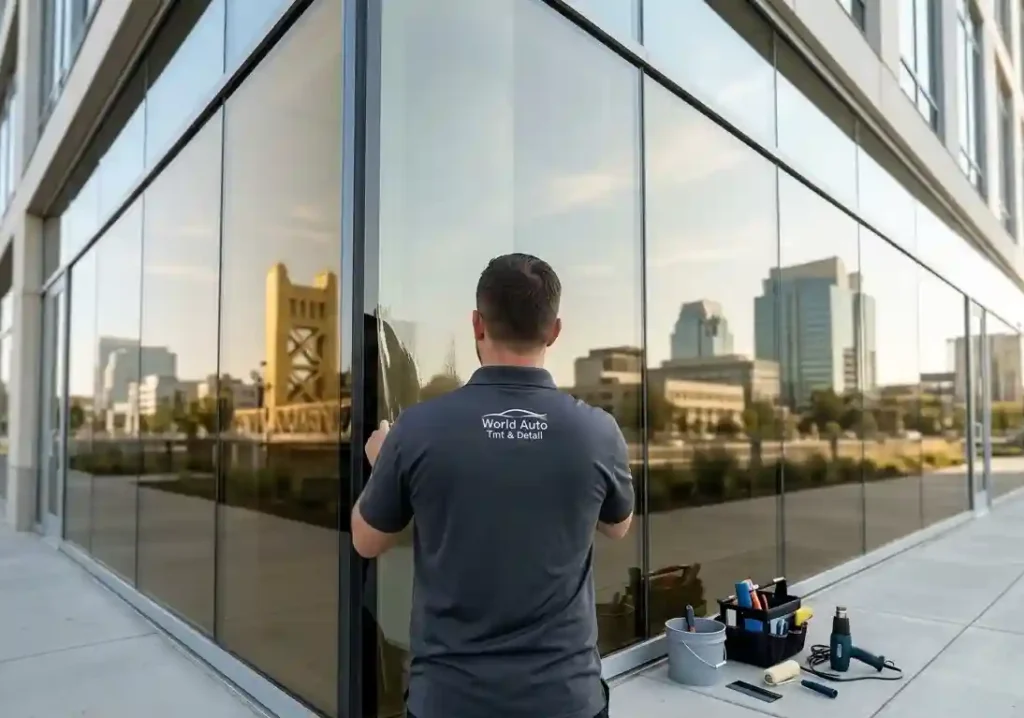
Solar control film reduces solar heat gain — the amount of the sun’s energy that passes through the glass and becomes heat inside your building. Less heat coming in means less heat your HVAC has to remove, which reduces runtime during peak cooling hours.
Two things determine how much you get back:
- Your glass and orientation. A west-facing single-pane storefront has far more to gain than a north-facing wall of modern double-pane glass that already has a low-E coating.
- The film you choose. Films differ in how much infrared heat they reject versus how much visible light they let through. A film that keeps your space bright and one that maximizes heat rejection are not always the same product.
This is why an honest answer requires looking at your building. Anyone quoting a savings percentage before seeing your glass, your orientation, and your hours is quoting a brochure, not your building.
There’s a secondary benefit that’s easy to miss: reducing peak load matters more than reducing average load. If film shaves the hottest hours of your cooling demand, it eases the exact moment your system is most strained.
Want a real number for your building? Request a free assessment and we’ll evaluate your glass type, orientation, and hours before recommending anything.
Beyond Energy: What Else Commercial Film Does
Energy is usually the reason a business calls. It’s rarely the only thing they end up valuing.
Glare control. Cutting glare at eye level means blinds stay open, natural light stays usable, and staff stop fighting their screens at 3pm.
Fade protection. Quality film blocks the large majority of UV, which is the primary driver of fading in flooring, upholstery, and displayed merchandise. For retail, this protects inventory directly.
Safety and security film. This is a different product category from solar film, and worth knowing about. Safety film is a thicker, tear-resistant layer that holds glass fragments together if a pane breaks — from an impact, an accident, or an attempted smash-and-grab. It doesn’t make glass unbreakable; it makes broken glass stay in place instead of becoming shrapnel across a lobby floor.
Privacy and branding. Frosted and decorative films give conference rooms and medical offices privacy without building walls, and can carry logos or patterns.
Appearance. A consistent film across a facade makes a mixed-age building look intentional from the street.
The Risk Nobody Mentions: Glass Warranty and Thermal Stress
Here’s the part that separates a professional commercial installer from someone who normally tints cars.
Applying film to architectural glass changes how that glass absorbs and holds heat. On certain types of glass — particularly some insulated units, tinted or heat-absorbing glass, and panes with existing edge damage — the wrong film can raise the risk of **thermal stress**, where uneven heating causes the pane to crack. On top of that, applying film can affect the glass manufacturer’s or the sealed-unit warranty.
This is a real constraint, not a scare tactic, and it’s manageable — but only if someone checks first. That means identifying the glazing type before recommending a film, and matching film to glass rather than selling one product to every building.
If you’re leasing, there’s a second layer: many commercial leases require landlord or property-management approval before modifying the building envelope. It’s a short conversation, but it’s better to have it before installation day than after.
We assess this on every commercial job before quoting. If a particular film isn’t appropriate for your glazing, we’ll tell you and recommend one that is.
Choosing an Installer: What Actually Differs
Commercial glass is not a bigger version of a car window. Here’s an honest comparison of what each option delivers — verifiable differences only:
| General Handyman | Typical Tint Shop | World Auto Tint | |
|---|---|---|---|
| Glazing type identified before quoting | Rarely | Varies | Yes |
| Thermal stress / glass warranty checked | No | Varies | Yes |
| Film matched to glass type | No | Varies | Yes |
| 3M authorized product line | No | Varies | Yes — authorized 3M dealer |
| Lifetime workmanship warranty | No | Rarely | Yes |
The pattern is the same as with any glass work: the cost of getting it wrong shows up months later, in a cracked pane or a voided warranty, not on installation day.
Why Sacramento Businesses Work With World Auto Tint
We’ve been on Arden Way for over a decade, and commercial work runs on the same standard as everything else we do — the assessment happens before the quote, not after.
- 900+ five-star Google reviews from Sacramento customers.
- Authorized 3M dealer with factory-trained, certified installers.
- Lifetime workmanship warranty on every install.
- 10+ years serving Sacramento businesses and drivers.
If your business also runs vehicles, we handle those too. Our full commercial window tinting in Sacramento service covers buildings and fleets from the same shop, on the same standard.
Frequently Asked Questions
What commercial window film energy savings can a business expect?
It depends on your glass type, building orientation, hours of operation, and the film selected. West- and south-facing single-pane glass has the most to gain; modern low-E double glazing has less. Rather than quote a percentage sight-unseen, we assess your building first and tell you what’s realistic for it.
Will window film crack my commercial glass?
The wrong film on the wrong glass can increase thermal stress risk, which is why glazing type should be identified before any film is recommended. When film is properly matched to the glass, this risk is managed. We check this on every commercial job before quoting.
Does window film void my glass warranty?
It can, depending on the manufacturer and the glazing. This is something to confirm before installation, not after — we review it as part of the assessment.
Do I need my landlord’s approval?
Usually yes, if you lease. Many commercial leases require written approval before modifying the building envelope. It’s typically straightforward, but worth handling before the install date.
What’s the difference between solar film and security film?
Solar film targets heat, glare, and UV. Safety and security film is a thicker, tear-resistant layer that holds glass fragments in place if a pane breaks. They serve different purposes, and some buildings benefit from both.
Can film help with privacy in conference rooms?
Yes. Frosted and decorative films provide privacy without construction, and can be cut to include patterns or company branding.